Beauty, but Make It Refill: L’Oréal’s Quiet Disruption of Malaysia’s Beauty Habit
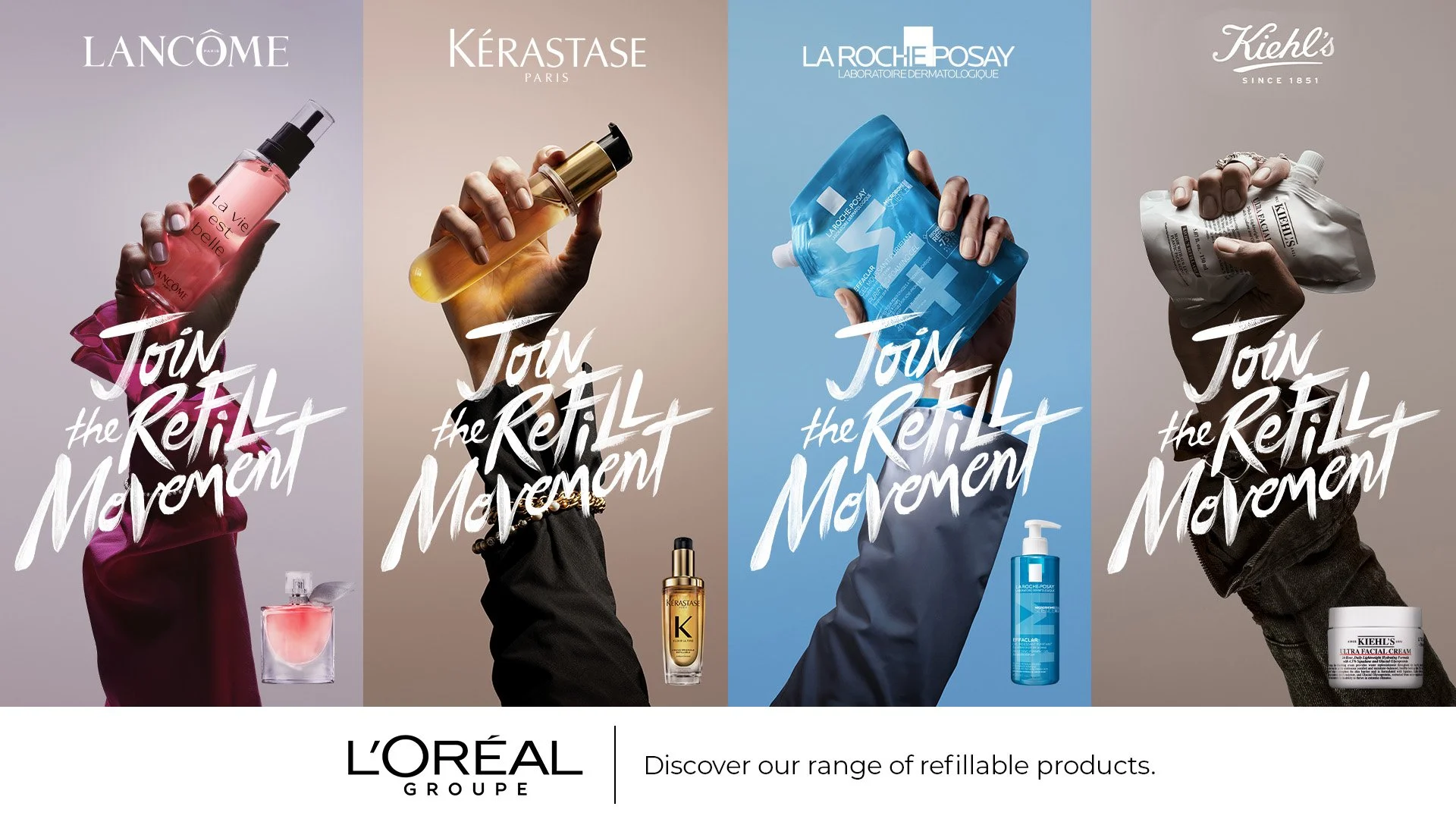
There’s a shift happening in beauty, and it’s not loud or flashy. It doesn’t arrive in a limited-edition palette or a celebrity campaign. It shows up in something far more ordinary: a refill.
Ahead of World Refill Day on 16 June, L'Oréal Malaysia is pushing that idea into the mainstream with its Refill Movement, spanning 7 brands across 3 divisions in Malaysia. The aim is simple but ambitious, making refillable beauty visible, easy to find, and actually part of everyday routines rather than a niche consideration.
Because the gap right now is not intent, but access. While 84% of consumers already want to make more responsible choices, many still don’t. Globally, 42% of consumers are unaware that refillable beauty even exists, and 43% say they cannot find it on shelf. The Refill Movement is positioned as a response to exactly that disconnect.
Across luxury fragrance, professional haircare, dermatological skincare, and everyday beauty, L’Oréal is bringing refill formats together under one umbrella, cutting across categories and price points. The message is not about switching routines, but about rethinking how those routines are packaged.
There is also a more practical angle here that tends to get overlooked in sustainability conversations: cost. Globally, 87% of consumers say they would choose a refill to save money. In other words, sustainability is increasingly aligning with financial sense, not just environmental intent.
And the impact is not abstract. It is measurable at the product level. A La Roche-Posay refill product format delivers a 73% reduction in plastic compared to a standard bottle. A Lancôme La Vie Est Belle refill reduces glass by 74%, metal by 100%, and plastic by 63%. These are not incremental tweaks. They are structural changes in how beauty products are designed to be consumed.
“Every refill gesture asks nothing more than a choice — and behind that choice is a product engineered without compromise, in packaging designed to do more with less. That is what responsibility built into a product looks like, and for Malaysians, that product is already within reach,” says Natasha Karim, Sustainability Lead of L'Oréal Malaysia.
The movement is also part of a longer arc rather than a one-off campaign. Since 2019, L’Oréal has expanded its refillable range 3.7 times globally and now sources 44% of its packaging materials from recycled or biobased origins. That progress is supported by a €100 million innovation programme focused on next-generation packaging solutions.
It also ties into a broader corporate target: reducing overall packaging intensity by 20% by 2030. The ambition is not just to introduce refillable products, but to make them structurally normal across categories.
“The Refill Movement invites Malaysians to discover that the most beautiful choice and the most responsible one are the same—a commitment that directly mirrors our nation’s visionary ambition for environmental stewardship. This belief has shaped our 30-year legacy in Malaysia, and it will guide every step we take toward a sustainable future,” says Tomas Hruska, Managing Director of L'Oréal Malaysia.
What stands out in Malaysia is how widely this is being distributed. From luxury counters to pharmacy shelves, refillable beauty is no longer confined to a specific segment. It is now present across categories and price points, integrated into brands consumers already recognise and use.
The participating refillable products are now available at major retail partners including Sephora, Watsons and Guardian, as well as on Lazada and L’Oréal’s own digital platforms. The intent is straightforward: remove friction. Make the responsible option the easy one.
Because in beauty, the smallest habits tend to be the most repetitive. And if refill becomes one of them, the shift stops being a campaign and starts becoming culture.